Spectre
One integer seed in, a complete and editable MIDI composition out — reproducible exactly, every time.
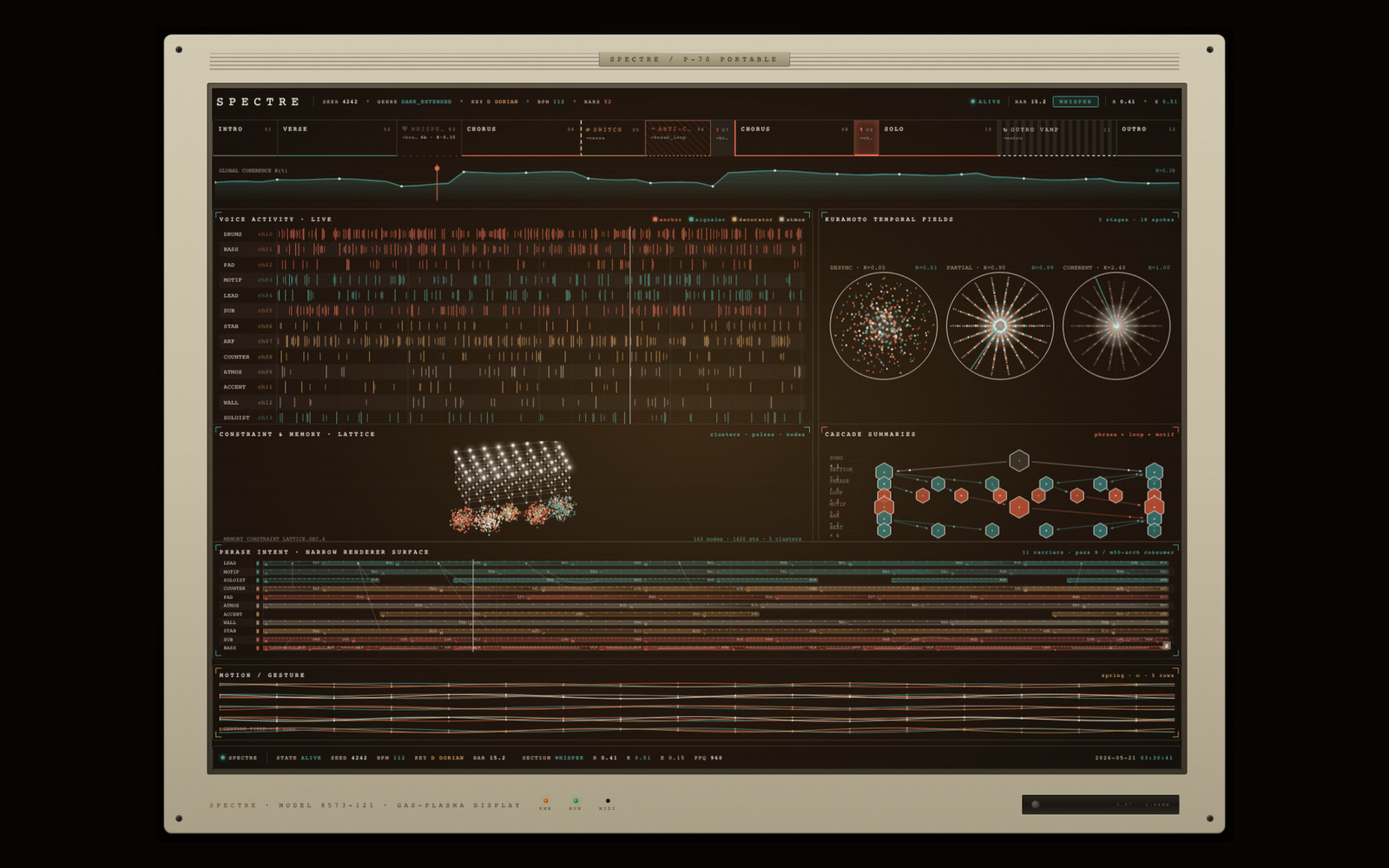
A generative composition system that takes a single integer seed and resolves an entire piece from it: section sequence, functional roles, energy arc, harmony, orchestration, recurrence and performance timing. It is deterministic by contract rather than by luck — the same code, inputs, dependency versions and seed produce byte-identical MIDI and trace output, via seeded PRNG state plus typed SHA-256 keyed sub-decisions. That makes a render not just repeatable but debuggable: a passage you dislike can be traced to the decision that produced it. The mechanisms are named, physical and inspectable — Hopf oscillators driving event production, Kuramoto coupling for coherence, genre-parameterised spring-mass dynamics for motion through pitch and register, plus harmonic constraint, memory tiers and form logic, each with an explicit owner and trace surface. Output is Type 1 MIDI at 960 PPQ across up to thirteen tracks: drums plus twelve pitched roles — bass, sub, pad, atmos, wall, stab, arp, motif, lead, counter and accent among them — so it arrives in a DAW as material to work with rather than a bounce. Composition, not a loop generator.
Category: audio
Tech: Python, MIDI, Kuramoto / Hopf oscillators, Cloudflare Workers, macOS app
Role: Creator